

The third of the Five Obsessions of Elite Organizations®
Optimized Playbooks
If you’re like most of the founders I’ve worked with, you have good people in clear seats, and they know why your company exists. Then a new hire starts, and the only way they learn the job is by following whoever did it before them. How your company actually gets its work done lives in the heads of a few experienced people, and every question routes through them.
That is where a lot of good companies stall. New hires take far too long to get up to speed, the same mistakes keep coming back, and you answer the same questions week after week. When one of those experienced people leaves, part of how your company works leaves with them.
Would it be unreasonable to spend about 10 minutes finding out how your company scores on Optimized Playbooks?
What Optimized Playbooks Means
Optimized Playbooks is the third of the Five Obsessions: Great People, an Inspiring Purpose, Optimized Playbooks, a Culture of Performance, and Growing Profits and Cash Flow. A Process Playbook is a short, high-level checklist for one of the critical processes in your company, from the trigger that starts it to the handoff at the end. Your team trains on it, follows it every time, and keeps improving it, and that is what makes it optimized.
It builds on the first two obsessions. Great People driven by an Inspiring Purpose still need to know the right way to do their jobs. Without that clarity, people with the potential to be great get blamed, and sometimes let go, for problems the company created by never giving them a playbook.
People Problem or Process Problem?
When leadership teams tell us about their frustrations, something about people almost always comes up. As we dig into why, we usually find a broken or missing process underneath it, and the person getting blamed never had a clear way to do the job right.
Here’s what that costs you. New hires get tossed into the deep end, so they guess or keep interrupting their colleagues for help. Your leaders get pulled down into the weeds to fight fires instead of looking ahead. Errors and rework eat into your margins, and eventually your customers feel the inconsistency and start looking at other vendors.
“The root cause of almost all issues in business is either one of people or process, and if you don’t have optimized Process Playbooks for people to train on and follow, you cannot always be certain that people are your problem.”
Playbooks Your Team Will Use Every Day
A lot of leaders put off playbooks because they picture the thick manuals they saw at a larger company, which people rarely opened. The most common reason, though, is being too busy firefighting, which means being too busy and distracted to do the very thing that would keep you from being too busy and distracted.
A playbook your team will use is short, kept in one place that is easy to find, and written for people who have already been trained on the details. At Next Level Growth, our playbook for a new prospect has just thirteen steps. One of them is “Create a new lead in CRM.” The playbook doesn’t explain which buttons to click, because the training covers that.
Playbook vs SOP
A Process Playbook is the roadmap for a process: the starting point, the destination, the best route, the major milestones and the key sub-steps. An SOP manual, or detailed work instructions, is the turn-by-turn directions for each task inside that roadmap, down to which buttons to click.
Playbook
the roadmap- Length
- A short, high-level checklist. Our playbook for a new prospect has thirteen steps.
- Who writes it
- A handful of the best people who do the work, led by the leadership team member who owns the process.
- What it covers
- One critical process, from the trigger that starts it to the handoff at the end.
SOP manual
turn-by-turn directions- Length
- Often hundreds, if not thousands, of pages.
- Who writes it
- Often written to meet a requirement, such as a certification, and rarely opened once it is met.
- What it covers
- Every task in detail, step by step, for consistency and compliance.
What It Looks Like When a Leadership Team Gets It Right
One of our clients is an HVAC distributor that sells equipment and parts to HVAC contractors. Their Process Playbooks had been in place for years, but there was friction between sales and operations. When a contractor had a problem with new equipment, a technical service advisor, or TSA, on the operations team worked it out with them. If the contractor kept rejecting the solutions, the TSA might replace the entire system, which could easily be a ten-thousand-dollar decision, or close the request and leave the contractor upset. The salesperson who owned that relationship often didn’t know there was a problem.
When their Next Level Growth Business Guide asked whether they had a process that should prevent this, the first answer was yes. Then he had them walk through it while he mapped it on the whiteboard, and the missing step showed up. Now, before any further solutions or negotiations, the TSA escalates the request and brings in a manager from the sales team.
They also had to decide who owns the final decision. Because their purpose and their differentiation put the customer experience first, they gave it to sales. That decision came straight from their Inspiring Purpose. It ended the friction between the two teams and cut down the number of contractors who walked away from a request unhappy.
What Goes in a Process Playbook
Every playbook starts by answering six questions. What is the overall purpose of this playbook? What triggers the process to start? What is the desired outcome? What should we measure? Who receives the handoff? Who owns it? From there, you write each main step in order, with its sub-steps underneath, from the trigger to the handoff. Write down what you should be doing, not just what you do today, and add the measures to your team’s Scorecard so you can see whether the playbook is being used and getting the results you want.
The book lists the playbooks most companies need:
- People Journey
- Marketing
- Sales (or Business Development)
- Operations
- Accounting
- IT
- Client Satisfaction or Customer Service
Which Playbook to Write First
Start where it hurts most. Ask your leadership team where your greatest frustrations are, and what your customers complain about most often. Most companies end up with ten to twenty critical playbooks, and starting with your biggest sources of pain removes them first. While you write, document the 20 percent of the steps that get you 80 percent of the results.
Build each playbook around your best people. Bring a handful of the best employees from that part of the business into a room for two hours, with the leadership team member who owns the process leading the conversation. The people who do the work every day know where the process breaks.
Turning Your Playbooks Into Training
Your playbook is the checklist, and video is the fastest way to train people on the details behind each step. When we built ours, I asked my executive assistant to record her screen the next time she added a new lead to our CRM, and to talk through it as if she were teaching a new hire. She was recording work she had to do anyway, and now a new assistant follows along with that video until they don’t need it.
The same idea works anywhere. Some of our manufacturing clients use cell phone videos to show how to set up a machine, and some of our hospitality clients use them to show how to greet a guest and how to work with an unhappy one. Then walk every employee through the playbooks for their role, regardless of tenure, so everyone knows what is expected.
The Optimized Playbooks Tools From the Book
These are the tools from the Optimized Playbooks chapter, and what each one helps your leadership team do.
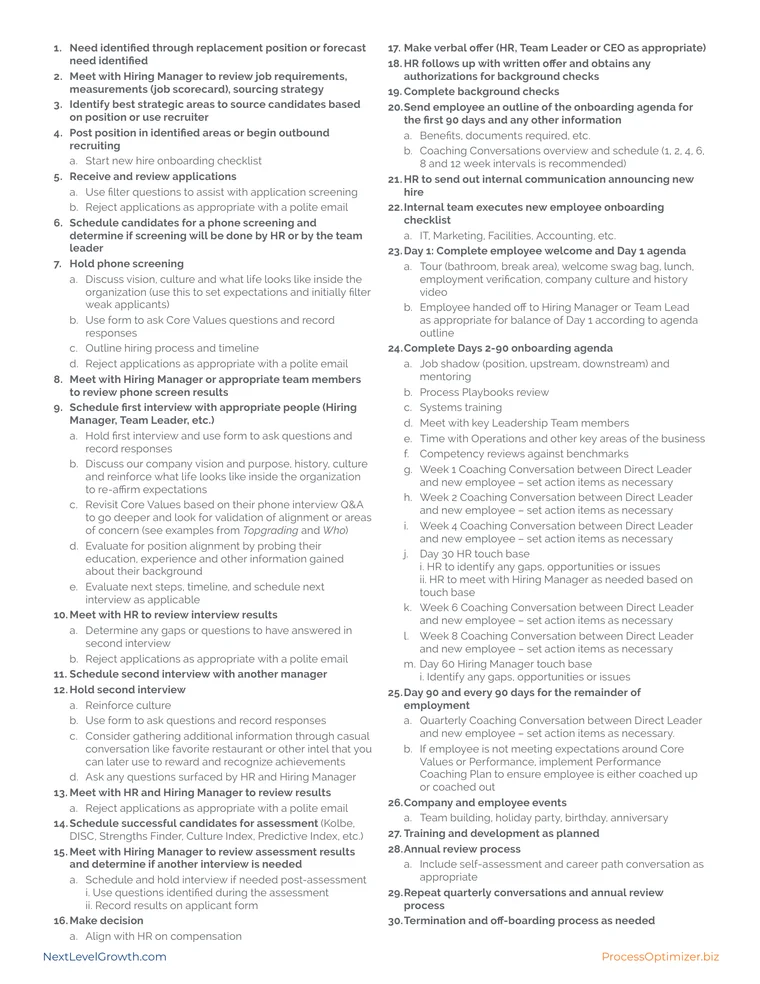
Process Playbooks
A short, high-level checklist for each critical process, from the trigger that starts it to the handoff at the end.
In Chapter 5 of the book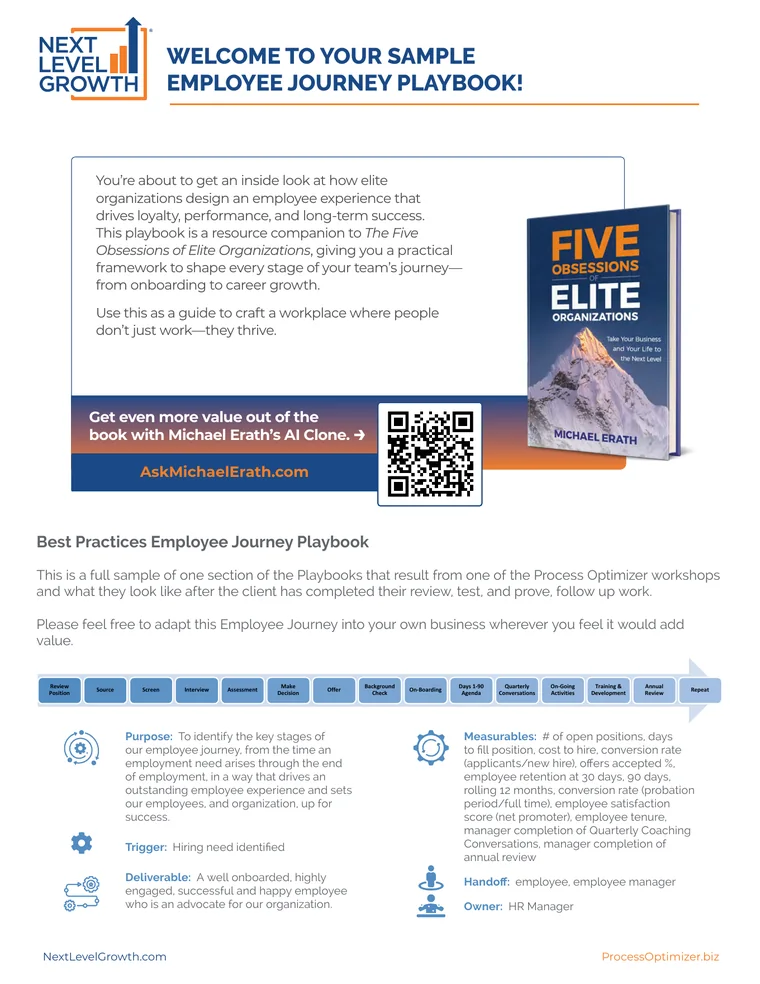 Free download
Employee Journey Playbook
A sample Process Playbook for the employee journey that shows your team what a finished playbook looks like.
Free download in the Tools librarySample Employee Journey Playbook, PDF
Michael on Optimized Playbooks
In this short video, Michael explains why elite organizations obsess over their playbooks.
A Client’s Story, in Their Own Words
“Next Level Growth helped us get a cohesive leadership team and establish clear accountabilities throughout the organization. We now have a proven playbook for the business, which clients, prospect and employees all love.”
 Kenneth Steiness, CEO of Sensei Project Solutions

Get the Book
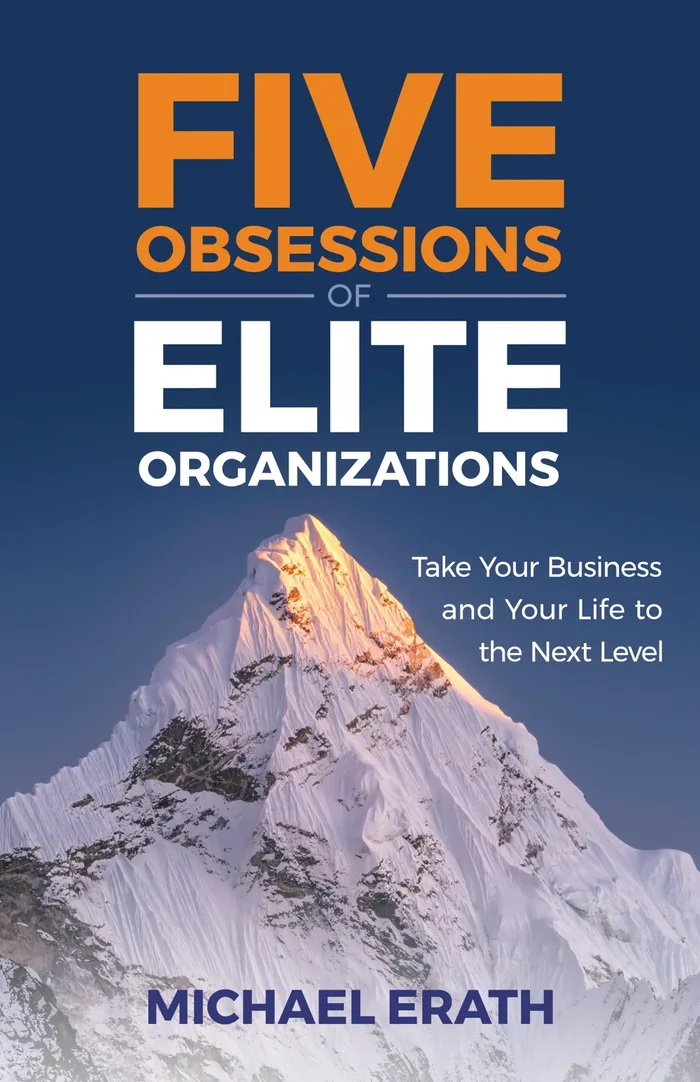
The chapter on Optimized Playbooks gives you a step-by-step way to build your first playbooks yourself, a simple onboarding process for a new hire’s first ninety days, and two ways to keep your playbooks current. It comes with a sample Process Playbook for the employee journey.
Is it a bad idea to read a chapter tonight and see whether it describes your company?
Ready for the whole book? See every format

Go Deeper on Optimized Playbooks
For the step-by-step work of building your playbooks with your team, read the full article on nextlevelgrowth.com.
Five Quick Questions About Optimized Playbooks
What makes a playbook optimized?
Your team uses it, everyone in the role has been trained on it, and it keeps getting better. Every time an issue comes up, ask whether you have a documented process that should have prevented it. If you don’t, write one. If you do, the process usually needs another step or a better one.
Which playbook should we write first?
Write the one behind your greatest frustrations or your customers’ most common complaints. Starting there removes your biggest sources of pain first, and your team sees the payoff while you build the rest.
Who should write our playbooks?
A handful of your best people from that part of the business should write it, led by the leadership team member who owns the process. Each leadership team member owns their team’s playbooks, including keeping them current.
How long does it take to build our playbooks?
Most companies that do it themselves take close to a year to build their ten to twenty critical playbooks, alongside everything else they’re working on. Companies that bring in an outside expert to do the heavy lifting can have a working draft in a matter of weeks.
How do we keep playbooks from going stale?
There are two ways. Fix the process every time an issue shows that a step is missing or broken. And at least once a year, have the leadership team member who owns each playbook review it with their best people, and ask a few people from the team that receives the handoff whether anything in it causes them problems.


Find Out Where Your Company Stands
Optimized Playbooks is one of five scores in the Elite Organizations Assessment. It only takes about 10 minutes, and one of our team members emails you a free personalized findings report within 1 business day.
Is it a bad idea to see your highest and lowest scores before your next leadership team meeting?
Take the assessment