

The fourth of the Five Obsessions of Elite Organizations®
A Culture of Performance
If you’re like most of the founders I’ve worked with, you’ve put real work into your people, your purpose and your playbooks. Your team knows what to do and why it matters. Then you look at the results, and it’s hard to tell who is winning and who is falling behind, because the numbers only show up once a month, if at all.
That is where a lot of good companies stall. People stay busy, and busy starts to pass for results. The leaders who are falling short keep getting a pass because they’re doing the activities, and your best people notice that the standard isn’t the same for everyone.
Would it be unreasonable to spend about 10 minutes finding out how your company scores on a Culture of Performance?
What a Culture of Performance Means
A Culture of Performance is the fourth of the Five Obsessions: Great People, an Inspiring Purpose, Optimized Playbooks, a Culture of Performance, and Growing Profits and Cash Flow. It is a commitment across your company, starting with your leadership team, to the same high expectations for results. Everyone knows the standard, everyone can see the score, and every leader coaches their people against it, so high performance becomes the normal way your company works.
The book builds it on five things: Scorecards and Scoreboards, Growth Rocks, the right meetings, a feedback loop, and a coaching system. None of them work without the first three obsessions in place.
Why Leaders Wait Too Long to Act
John Wooden said to never mistake activity for achievement. Far too many companies give a leader or a team a pass for too long because they are doing the activities, even when they aren’t getting the results. When the person is someone you’ve worked with for years, or a family member, or someone who helped build the company, the conversation gets harder to start.
I’ve seen far too many leaders complain about the same person quarter after quarter and keep saying, “I’m working with them and coaching them.” While you wait, the rest of your team carries the load, and your high performers start wondering why they work so hard. A-Players want to be held to a high standard, and they want to work with people who are held to it too.
“Your leadership team runs your business. You will get what you’re willing to tolerate. If someone stands in between your leadership team and doing what’s best for the company, then that person runs your business.”
Holding a High Standard With Respect
Holding the standard starts with coaching. When someone falls short, have one or two Coaching Conversations: be clear about what is expected, give specific examples of where they missed it, and agree on what has to change. When they respond, you’ve coached them up.
When they don’t, move to a Coaching Plan. It’s a formal process, with up to three scheduled meetings two to four weeks apart, a witness in the room and a signed form each time. Many leaders resist the formality, but the formality is the power behind it, because it takes the emotion out of the decision and gives the person every chance to improve. Some people get back on track, some move into a seat that fits them better, and some leave on their own before the last meeting. If you want it more for them than they want it for themselves, it will never work out.
What It Looks Like When a Leadership Team Gets It Right
Soon after we started Daily Huddles with our front-line production teams at Erath Veneer, Joy spoke up. She had fed veneer into Dryer #3 on the first shift for several years and had been with us for more than two decades. When her lead asked if anyone needed anything before the shift started, Joy said that the day before, she had started hearing a noise she hadn’t noticed before.
Her lead, Elaine, whom we all called Red, asked the first-shift supervisor to send someone from maintenance. Jeff stood with Joy at her station for a few minutes and recognized the faint sound as the very early sign of a bearing starting to fail. If that bearing had failed with the dryer full, everything inside, easily worth several thousand dollars, would have been ruined, and damage to the screen could have cost tens of thousands of dollars to repair.
Instead, the team ran the dryer until it was empty, maintenance changed the bearing over lunch, and the dryer was running again by the time everyone came back. The team didn’t lose any production that shift. It happened because Joy had a place to speak up every day and a team that acted on what she said.
Why It Depends on the First Three Obsessions
You can’t build a Culture of Performance on the wrong people. You need Great People who share your core values and have the skills and drive to perform in their seat. They need an Inspiring Purpose they can make their own, so they understand how their work affects other teams, your customers and where the company is going. And they need Optimized Playbooks, so the work flows the same way every time.
Get those three right and a Culture of Performance has something to stand on. Skip them and you end up holding people accountable for results they were never set up to deliver.
Scorecard vs Scoreboard
A Scorecard is the set of numbers your team reviews every week in its Weekly Tactical Meeting to see where it is meeting expectations and where it is falling short. A scoreboard is like the one in any sport, the live results the players on the field can see while they’re playing the game.
Each person on your leadership team has one Most Critical Outcome®, and each Most Critical Outcome® usually has two to four key drivers. Those drivers go on the Scorecard, and the person in the seat owns them, so a leadership team of four tracks somewhere between eight and sixteen numbers every week.
When I was president and CEO of Erath Veneer, we had eight production teams across four production lines and two shifts. We set a throughput goal for each team based on the species and the line it was running, and any log that failed the next morning’s quality check came off that team’s total. Every day we posted a bar graph by the break room door showing each team’s goal and actual results from the day before, green if they hit it and red if they missed. Without any financial incentives, average throughput per shift went up 8 percent.
What Is a Quarterly Calibration?
A Quarterly Calibration™ is a one-to-one meeting, once a quarter, between a leader and each direct report about core values and performance. It lasts ten to thirty minutes and should feel like a casual check-in, not a formal review. Before you meet, you both rate the last ninety days on each core value and on the Mission, Most Critical Outcome® and Obsessions for their seat, then you compare notes one item at a time. It confirms for your high performers that they’re doing well, and it shows you early who needs coaching.
Growth Rocks set each quarter’s priorities alongside it. A Growth Rock is a big project that won’t get done in the normal course of business unless someone owns it and it has a due date, and the idea builds on Stephen Covey’s First Things First. Write each one so it’s clear what you’re trying to accomplish and how you’ll know it’s done, then break it into milestones with their own dates so nobody crams it in at the end of the quarter.
The Tools for a Culture of Performance, From the Book
These are the tools from the Culture of Performance chapter, and what each one helps your leadership team do.
Scorecards and Scoreboards
The weekly numbers your team reviews together, and the live results your front line sees while it works.
In Chapter 6 of the book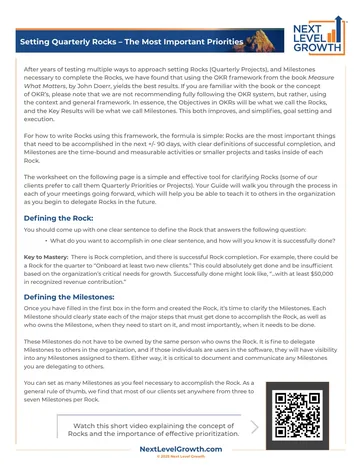 Free download
Growth Rocks
A worksheet that turns each quarter’s biggest project into one clear sentence, one owner and dated milestones.
Free download in the Tools libraryRock Setting Worksheet, PDF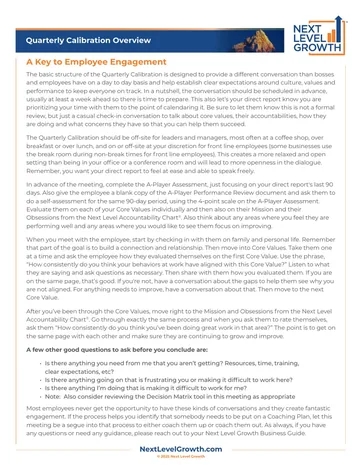 Free download
Quarterly Calibration™
A short conversation every quarter between each leader and each direct report about core values and performance.
Free download in the Tools libraryPerformance Evaluation Review, PDF
Michael on a Culture of Performance
In this short video, Michael walks through how a Quarterly Calibration™ works.
A Client’s Story, in Their Own Words
“I wholeheartedly recommend Next Level Growth to any organization seeking to build a tighter leadership team, increase accountability and clarity, unlock their full potential, and achieve extraordinary results.”
 Alex Stavros, Former CEO of Embark Behavioral Health

Get the Book
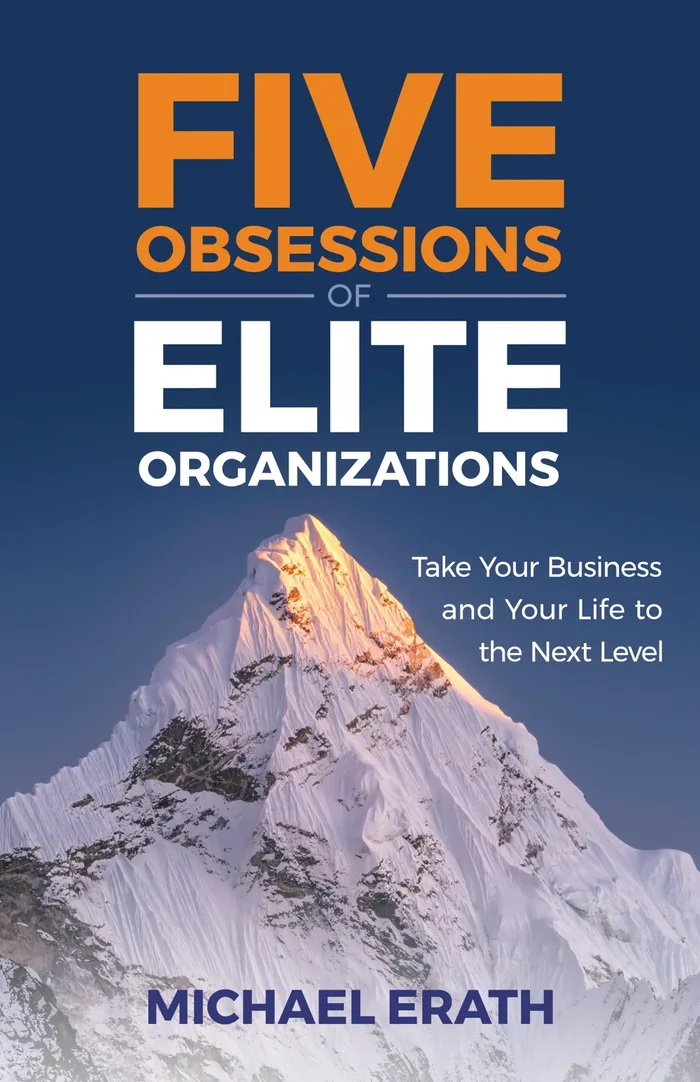
The chapter on a Culture of Performance walks through the five building blocks, including the full agenda for a Weekly Tactical Meeting, how to run Daily Huddles, and the Coaching Plan process step by step. It comes with the Rock Setting Worksheet and the A-Player Assessment you use for each Quarterly Calibration™.
Is it a bad idea to read a chapter tonight and see whether it describes your company?
Ready for the whole book? See every format

Go Deeper on a Culture of Performance
For the step-by-step work of building a performance culture with your leaders, read the full article on nextlevelgrowth.com.
Five Quick Questions About a Culture of Performance
What should a leader do about an under-performer?
Start with one or two Coaching Conversations that make the expectation clear, give specific examples, and agree on what has to change. If that doesn’t work, move to a Coaching Plan, a formal process of up to three meetings two to four weeks apart. Either the person improves, moves into a seat that fits, or leaves.
Who owns each number on a Scorecard?
The person in the seat it measures. Each number is either someone’s Most Critical Outcome® or one of the two to four key drivers behind it, so every number on the Scorecard has one name next to it.
Will a performance culture scare off good people?
It usually scares off the people who weren’t performing. Nick Saban put it this way: “Mediocre people don’t like high achievers, and high achievers don’t like mediocre people.” A-Players hunger for clear goals and healthy competition, and a Culture of Performance gives them both.
How do you reward high performers without a big bonus budget?
Start by making results visible. At Erath Veneer, posting each team’s results by the break room door raised average throughput per shift 8 percent before we paid anyone a bonus. Once we had consistent data, we reinvested some of the gains into a bonus program for the best-performing teams.
What is a Daily Huddle?
A Daily Huddle is a short meeting with a front-line team just before each shift. At Erath Veneer, the lead covered three things: how the team did against yesterday’s goal, today’s goal and anything that could get in the way, and whether anyone needed anything before they got started.

Find Out Where Your Company Stands
A Culture of Performance is one of five scores in the Elite Organizations Assessment. It only takes about 10 minutes, and one of our team members emails you a free personalized findings report within 1 business day.
Is it a bad idea to see your highest and lowest scores before your next leadership team meeting?
Take the assessment